Limassol Archaeological Museum
- 14 сент. 2017 г.
- 4 мин. чтения
Today I will tell you about the Archaeological Museum in the city of Lemesos (Greek, Λεμεσός), as it is called by the Greeks and Cypriots. The Archaeological Museum of Limassol is located near the coast of Lemesos, near the crossroads of Makarios. One-story building of the museum is located on the territory where visitors are greeted by a garden and a fountain, and 5th century, captured the scene of "Aphrodite for bathing and Cupid, holding a mirror".
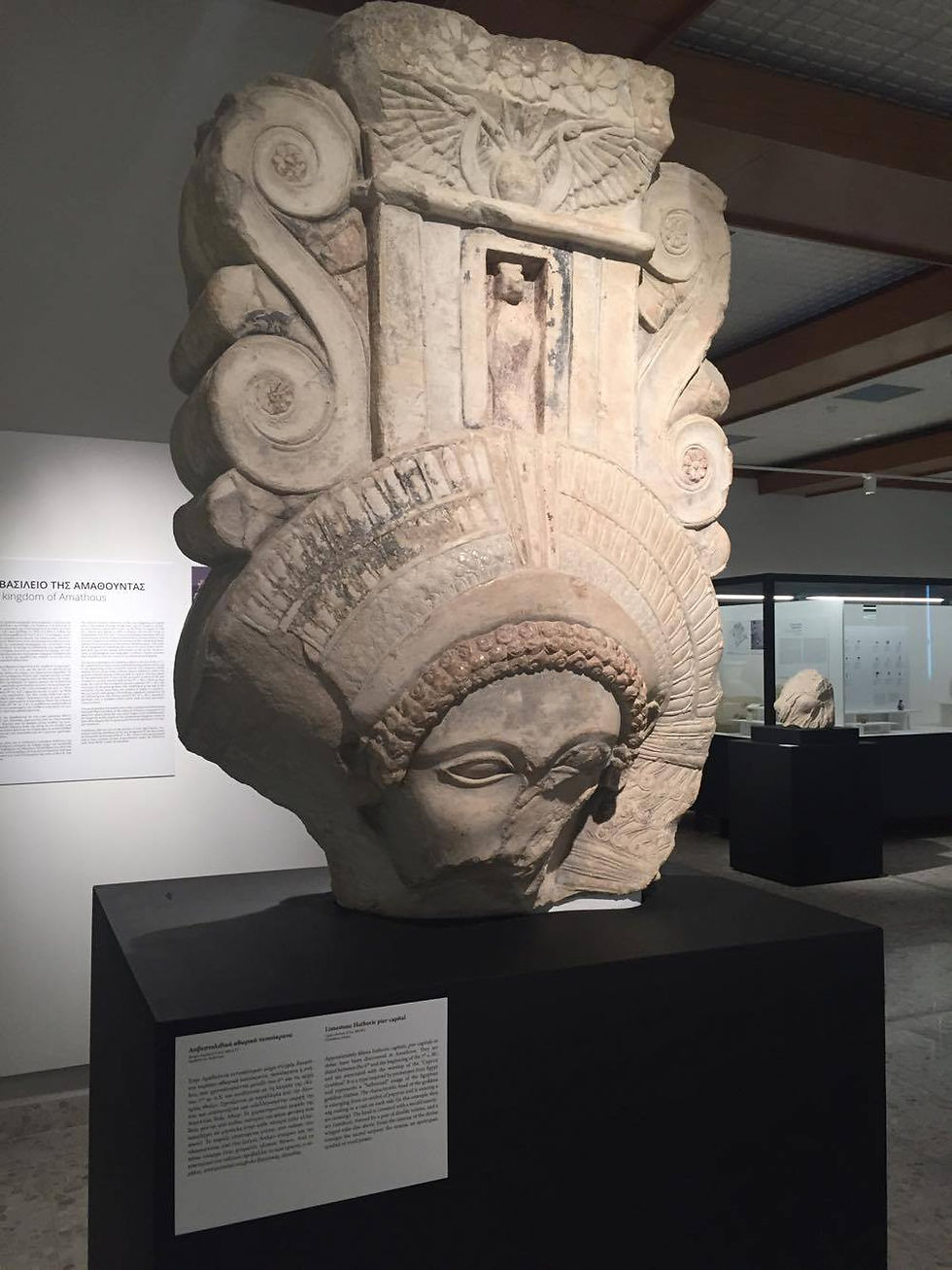
Limestone Hathoric pier-capital
In the museum there are four huge halls, connected by showcases with exhibits and corridors, in which there is a permanent exposition. As a rule, it focuses on finds dating from the Neolithic times to high classics. Also in the museum there is a huge collection of painted ceramics, sculptures and arts and crafts.
In the first hall of the collection of a huge collection of ceramics: the period of medium bronze (1900 - 1650 BC), late bronze (1650 - 1050 BC), geometric period (1050 - 750 BC. e.), ceramics of the period of the archaic (750-475 BC), as well as the so-called cypro-archaic period (700-475 BC) and, of course, the ceramics of the classical period ( 475 - 325 BC). The museum has a large number of ceramic ritual purposes (funerary culture), as well as cigars for drinks, craters for mixing wine with water, ono-chino for wine, and several pics for storing elements of women's toilet and perfumery. In the windows you can also see the ceramic figures of animals, servants, midwives, and even Egyptian gods (eg, Bes).

Amphoriskos of Bichrome V
Decorated in the "Amathous Style", depicting a rooster
Cypro-Archaic II (6th c. BC)
Amathous Tomb 470/43
The museum has a lot of ceramics. In particular - the style of Fichelur (many water and vegetative mesh elements, sometimes there are animals). Speaking of ceramics, I would like to draw your attention to the next exhibit. It would seem that there is nothing special about it: Mediterranean life, Greek policies, Aegean motives. No detailed image. Only light "engines" brush, no naturalism and the desire to convey the accuracy of the animal. But, looking at how the artist chooses the direction of the bodies of fish, which gives the dynamism of the surface of this pottery makes them admire.

Juglet of Bichrome V with painted fish representations
Cypro-Archaic II (6th c. BC)
Amathous Tomb 321/4
After the hall with ceramics, on the left side, you will be greeted by a new exhibition called "ΑΜΑΘΟΥΣ". The exhibition, which is devoted to the discovery and study of the city of ΑΜΑΘΟΥΣ (Amathous - lat.). The last archaeological excavations of which were carried out in 2000. After that, a lot of artifacts were found, objects of fine art, which give an opportunity to study the political aspects of the city better (interacting with Assyria, Egypt, and of course, later with Byzantium), and its way of life, trade and culture (funerary cults, motherhood, religion). In particular, several incredible sculptural parts of temples and columns, sarcophagi, and much more were found.
At a high level in the museum infographics and accompanying texts are made. Very qualified translations from Greek into English. The texts completely tell about the history of the city and you do not need to be afraid that you do not own a "background" in order to "understand" or "read" the exhibits.
As it is commonly believed, one of the deposits of Aphrodite is the island of Cyprus and you do not need to believe it (as most Russian tourists do), but when you see this wave full of foam, you really want to believe it. What was mentioned Aphrodite, you certainly want to ask. All because the name of the city of Amathous was taken from mythology. Or rather, on behalf of the son of Hercules (according to one version), and on the other - on behalf of the mother of the ruler Kinioros, who, according to the myth, was very dear to Aphrodite. 🕊
In the last part of the hall, where the exhibition "ΑΜΑΘΟΥΣ" is located, there are objects of ritual and funerary cults together with a sculpture. In the hall there are about 10 items of funeral cult (in the form of stellas, pommel stella in the form of two lions, tombstones, sarcophagi). In particular, my attention was especially drawn to one of the exhibits, which I consider to be one of the most interesting. Namely - a stella dating from the 3rd century BC. (the Hellenistic period), which is a vivid example of the importance that was betrayed to the notion of death. After the stella was made, the following dyes were executed with natural dyes (on the example of this exhibit): with the deceased, who is sitting, the girl says goodbye (the figure on the left, look at the reconstruction, in the figure on the right). Interestingly, at the feet of the deceased is a small Cupid. But the attention of visitors, of course, attracts a huge sarcophagus. What was a pleasant surprise for me was the fact that the thematic music played softly in the museum in different halls. What is surprising, she did not distract at all. My 2.5 hours flew by unnoticed. It is worth thinking about this museum practice. I really liked it.

Funerary pedimental stele with painted decoration
Hellenistic period (3d c. BC)
Amathous Tomb 321/1
Chronological table on the exhibits of the museum:
PREHISTORIC PERIOD
Preneolithic period- Akroteri culture
10.000-8500 BC
Early Neolithic- Shillourokambos culture
8η-7η Χιλιετηρίδα
Neolithic I/ Classical Neolithic
6800-6000 BC
Neolithic II/ Late Neoilithic - Sotira culture
4500-3800 BC
Chalcolithic
3900/3800-2900/2500 BC
Erimi Culture
3600-2600 BC
Early Bronze Age
3000/2900-1900/1800 BC
Μiddle Bronze Age
1900-1600 BC
Late Bronze Age
1600-1050 BC
HISTORICAL PERIODS
Cypro-Geometric period
1100-750 BC
Cypro-Archaic period
750-500 BC
Cypro- Classical period
500-310 BC
Hellenistic period
310-50 BC
Roman period
50 BC-324 AD
Late Roman , Early Christian or Early Byzantin period
324–7th AD
Address: VYRONOS / SIOKRI STR.
Τ.Κ. 3405 TEL: 00357-5-305157 FAX: 00357-5-305173
Museum's Website:
#Cyprus #CypriotMuseums #Pottery #ArchaicPeriod #antiquités #MuseumProfessional #MuseumLife #MuseumLifestyle #MuseumLifestyleTravels #Museum #Art #ArtHistorian #HistoryOfArt #Exhibition #Collection #MuseumCollection #ArtLover #MuseumSelfie #ArtGallery #Gallery #Research #ArtNerd


Комментарии